Keystone Construction Performance
Guide to Construction Commercial Director services -
Consultant, Fractional or Interim?
We’re often asked how we deliver our commercial services and the optimum route for clients. Ultimately that depends on the client’s needs, and we have a fully flexible approach to answering these questions.
A keystone symbolises strength, unity, and a crucial central support that helps to hold a larger structure or system together.
For our clients, culture and performance are the keystones that support the fabric of their businesses.
At Keystone we aim to be part of that central support working with client’s to consistently reinforce and develop these keystones.
Trust and adding value are Key to us in our relationships with clients. That’s why we are particular with the clients we work with, to ensure that we have shared values–of trust, integrity, honesty and respect for all.
We also recognise that these traits are critical in return. When operating at the beating heart of a business, clients need certainty and confidence. Keystone provides that–strength, unity and crucial central support.
Many construction businesses reach a stage where projects are increasing in value and complexity, but there is no dedicated commercial leader to oversee risk, margin, cash flow and contractual compliance.
Without strong commercial leadership, profitable turnover can quickly become poor cash flow, unresolved contractual issues and reduced margins. An experienced Commercial Director helps protect profitability, improve commercial performance and support sustainable business growth.
The construction industry is a notoriously difficult environment with the highest company failure rate of any industry. Strong and effective commercial management is therefore essential. This is what an experienced Commercial Director provides, and includes, amongst other things:
-
Contractual due diligence - contract document reviews, risk identification, negotiation of terms and conditions, and risk mitigation measures.
-
Financial control and cash flow management - ensuring applications for payment are submitted accurately and on time, reducing payment delays and improving working capital. Ensuring necessary remedial action is taken if payment is not received on time.
-
Overseeing timely and compliant subcontractor payments - reducing supply chain payment disputes and building long-term effective working relationships.
-
Protecting and maximising profitability - by identifying, pursuing and securing contractual entitlements, variations and claims.
-
Risk management - identifying and managing potential and actual risks to ensure minimum negative impacts. Advising on compliance with contractual requirements.
-
Overseeing detailed and effective cost reporting and outcome projections - ensuring financial reporting processes are robust and accurate, and that expected outcomes are understood and realistic.
-
Advising on statutory and legal compliance matters - to avoid negative impacts of non-compliance
-
Strategy and business planning input.
-
People management and development.
Many successful construction businesses operate without a dedicated Commercial Director. This may be because they are still growing, remain founder-led, cannot justify a full-time senior appointment, or have struggled to recruit the right individual.
While these reasons are understandable, they often leave a significant gap in commercial leadership and strategic decision-making. But one which can be overcome by employing outside resource to provide the requisite cover.
At Keystone, we provide this experienced Commercial Director support to construction businesses of all sizes.
Whether you require strategic advice, ongoing executive leadership or temporary senior resource to manage a specific challenge, we provide flexible solutions tailored to your needs, without the cost and commitment of a full-time appointment.
These services can be provided in a number of ways to suit the client’s particular requirements. This guide provides clarification on the different roles to help clients understand their needs.
There are three principal formats in which such services are typically bought in - these being:
-
Consultancy,
-
Fractional,
and
-
Interim.
Consultancy
What is a consultant commercial director?
Consultancy is where an experienced individual is brought in, on a time basis, to provide additional support and input to help guide an existing management team.
A consultant reviews existing arrangements or particular issues/circumstances and provides advice and guidance, based on their knowledge and experience, as to a course of action to be taken. Undertaking the work is often dealt with fully or partially by existing business resources.
The role can be extremely varied in scope, from a very particular and defined piece of work to a much broader general advice and guidance role–or any combination of the two. It can also be time limited or ongoing, and the time commitment given can also flex with requirements.
Examples of activities suitable for consultancy input are:
✓ Strategic commercial expertise for a particular issue or circumstance.
✓ Ongoing commercial and strategic advice.
✓ Founder support.
✓ Risk management.
✓ Project turnaround.
✓ Dispute management and resolution.
✓ Continual improvement.
✓ Strategic recruitment advice and support.
✓ Staff mentoring and development.
✓ Executive mentoring and development.
✓ Non-Executive Director (NED) appointments.
Fractional
What is a fractional director?
A fractional director is an experienced executive who works for several businesses concurrently, giving each a defined slice of their time. Usually, one or two days a week, on a retained ongoing basis, and at a fraction of the cost of a full-time appointment.
They are not a consultant producing recommendations; they hold the role, sit within the leadership team, and are accountable for agreed outcomes within their remit.
A fractional Commercial Director gives a construction business senior commercial leadership on a part-time basis. Providing strategic and executive insight, extensive experience, and governance to businesses that don’t currently have such expertise.
Whether it is the right answer depends less on budget and more on whether the commercial problem you are solving needs continuous presence or periodic judgement.
The distinction from interim matters. An interim works full-time for a fixed period to resolve a defined situation. A fractional works part-time indefinitely because the business needs the capability continuously, but not to be continuously present.
When is fractional the right answer?
Four conditions point clearly toward a fractional Commercial Director:
✓ You need strategic commercial expertise without the cost of a full-time executive.
✓ Your commercial/operational team manages day-to-day commercial activities but lacks senior commercial leadership.
✓ Your business turnover has outgrown founder-led commercial management.
(Revenue is typically between £2m and £20m roughly. Below that the founder is usually still the commercial leader. Above that the role generally needs to be full-time. In between is where fractional typically works best. Providing consistent, ongoing input, knowledge and relationships, without the full-time costs.)
✓ You are preparing for growth, investment, acquisition or sale.
(Buyers and sponsors scrutinise revenue quality, commercial control, financial understanding and margin sustainability. Getting these in order is one of the clearest fractional use cases.)
When is fractional the wrong answer?
A fractional appointment is not always the right solution. In the following circumstances, an interim or full-time Commercial Director may provide greater value:
-
A large commercial team needing daily leadership.
Managing numerous people requires presence. One or two days a week will simply not cover it, and the team’s performance will be affected. Equally, a fractional director arriving to a backlog of questions and support requests, will not achieve those functions they are intended to deal with in the limited time period available to them. A fractional role is a regular strike mission with defined activities.
-
The role is significantly customer-facing.
If your largest accounts expect a senior commercial relationship available as and when, then a part-time director cannot realistically provide it. Key clients can read reduced availability as reduced importance, even if it is not.
-
The business is in a commercial crisis.
Losing major customers, facing a collapse in margin, dealing with significant commercial claims/losses or significant problem projects and needs full-time attention immediately. That is an interim requirement, not a fractional one. Though one may lead to the other and vice-versa.
Interim
What is an interim commercial director?
An interim commercial director comes in to fulfil the role on a full-time basis, but for a defined period of time, typically 3-12 months, to cover a particular situation. Examples might be:
✓ Temporary cover during an incumbent’s absence due to longer term illness.
✓ To cover a gap whilst recruiting a new permanent replacement.
✓ To cover maternity leave or other extended absence.
✓ A particular spike in workload.
How to choose the right format?
If you are looking for general advice, guidance and support, bringing into the business skills and experience that you wouldn’t otherwise have, or to undertake a particular piece of work, then consultancy is the way to go, and provides optimum flexibility.
The question we ask owners considering a fractional Commercial Director role is simple: do you need someone to do the work, or to decide what the work should be?
If it is the former, fractional will disappoint you, because one day a week does not stretch.
If it is the latter, it is often better than a full-time hire—you get someone more experienced than you could perhaps otherwise afford, and experience is exactly what commercial management decisions require.
A pattern seen most often in owner-managed businesses is the revenue growing while margin and cashflow quietly erode, usually because nobody owns the issues. That is a commercial leadership gap, and it rarely needs a full-time appointment to fix until turnover becomes more significant.
IIn simple terms:
-
Consultancy provides advice and recommendations.
-
Fractional provides ongoing commercial leadership on a part-time basis.
-
Interim provides full-time executive resource to manage a specific situation or transition
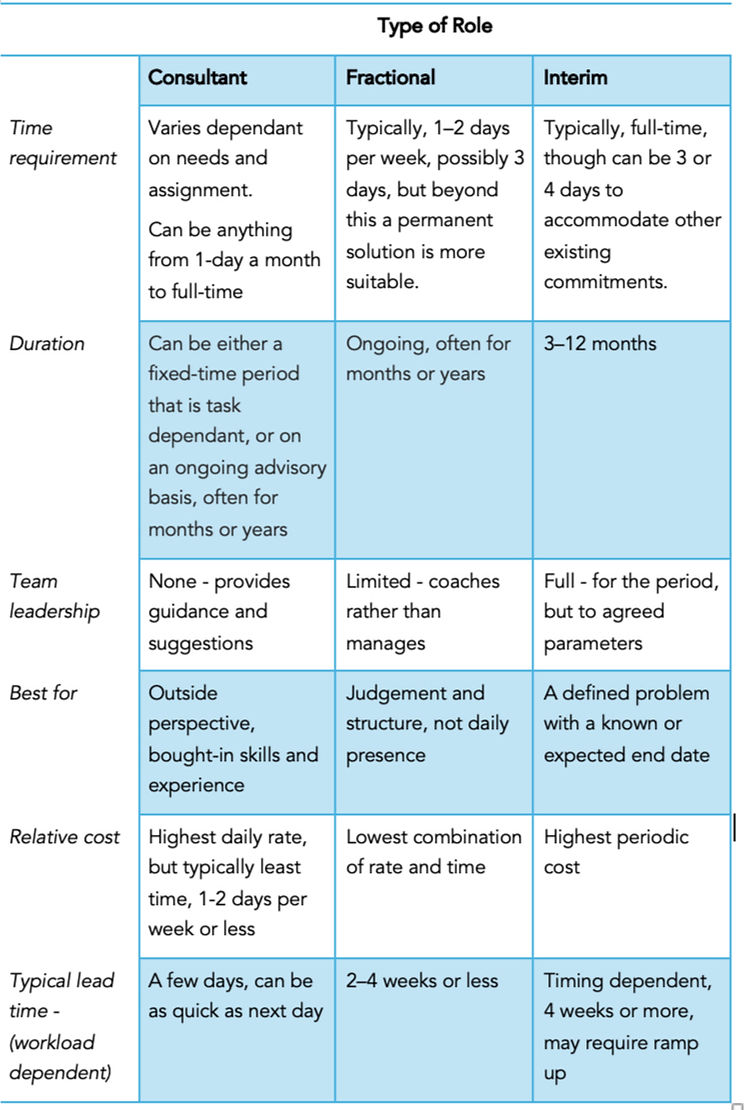
The table that follows provides further useful guidance:
Why Keystone?
-
Our Commercial Director services are delivered by Richard Brackstone, our founder and an industry veteran.
-
Extensive commercial leadership experience across the construction sector, incorporating both main contracting and specialist sub-contracting.
-
With over 40 years industry experience, of which more than 30 have been at executive level, Richard has probably lived your problems before.
-
Trust, integrity, honesty and respect for all.
-
Proven track record improving cash flow, margins and commercial performance.
-
Deep expertise in contract management, dispute avoidance and risk mitigation.
-
Demonstrable record of adding greater value than cost.
-
Thinking outside the box and challenging norms.
-
Flexible engagement models tailored to your business requirements.
-
Our success, comes from your success